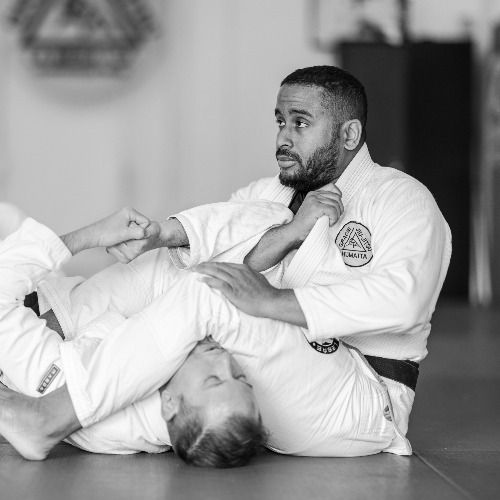
Episode 234
E234 | Choosing Your Intentional Mindset on the Mats
DFM Coaching Library:
https://www.patreon.com/cw/DFMCoachingBjj
About This Episode In this episode of Tapped In, David Figueroa-Martinez breaks down the importance of showing up to the academy with a clear, deliberate mindset. Most practitioners step onto the mats without a plan, reacting to whatever happens during the roll. David outlines the three core mindsets he uses to guide his own rounds: working an aggressive comp-style pace, shifting into pure economical defense when energy is low, and isolating specific positions or techniques from instructional study. Geared toward white through purple belts and fellow coaches, this discussion focuses on taking direct ownership of your mat time, experimenting without ego, and building longevity in Brazilian Jiu-Jitsu.
Key Takeaways
- The Aggressive Mindset (The "Comp" Day): Choosing to be assertive doesn't mean injuring training partners; it means actively dictating the pace, hunting submissions, refusing passive sweeps, and treating the round like your own personal competition prep.
- The Defensive Mindset (Economical Jiu-Jitsu): On days when energy is depleted or you are managing fatigue, shift into survival mode by prioritizing frames, minimizing unnecessary movement, remaining calm under pressure, and allowing yourself to work out of bad spots without ego.
- The Focused Objective (Position-Specific Intent): Rather than rolling aimlessly, pick a single technique or checkpoint from an instructional video—such as establishing half guard or securing an underhook—and measure success strictly by how often you reach that position, regardless of the finish.
Chapters
- 00:00 – Welcome to Tapped In & The Value of Intentionality
- 00:46 – Morning Classes vs. Evening Classes: Entering the Right Headspace
- 01:42 – The 3 Core Training Categories
- 02:08 – Mindset 1: Bringing an Aggressive, Comp-Style Edge
- 03:00 – Submission Hunting & Dictating the Round
- 04:47 – The Lesson from Tyler Bishop: Experiencing the Skill Gap
- 06:05 – Mindset 2: Economical Defense & Framing Under Fatigue
- 07:22 – Rolling with Royler Gracie: Smooth Mechanics Over Athleticism
- 08:52 – Mindset 3: Isolating a Specific Position or Technique
- 10:48 – Celebrating Small Mat Milestones
- 11:42 – Advice for Coaches: Encouraging Student Autonomy & Experimentation
- 12:54 – Connect with DFM Coaching: Instagram, Patreon & CoachNow Reviews
Are You You New To The Podcast? Start Here!
👉DFM Coaching Patreon Page
Everything here is pulled from real mats, real classes, and real conversations about what actually works. Choose the tier that fits where you are right now.
👉DFM Coaching In Person and Remote Coaching
DFM Coaching works with recreational grapplers who want to get better and actually feel it. Remote coaching and in person seminars available.
DFM Coaching Skool Community
Join the free DFM Coaching Skool Community, the space where the conversation continues after the episode ends. Mindset tools, mat culture, and a community of grapplers who take the mental side seriously.
👉 DFM Coaching | Bjj Skool Community.
Stay Connected
🌐 www.DFMCoachingBjj.com
DFM Coaching | Bjj Blog:
Long-form storytelling, deep strategy, and the philosophy behind the fight:
Affiliate Partner
BJJ Mental Models has one of the deepest conceptual Jiu-Jitsu libraries out there. I use it. I recommend it.
(Code: FIGUEROAMARTINEZ)
Help the Show Grow
If this episode gave you something, pass it on. Share it with a training partner, drop a review, or repost it to your story. That is how we keep the signal strong.
Stay tapped in,
David Figueroa-Martinez
Founder, DFM Coaching Bjj
Mentioned in this episode:
Patreon Blueprint Ad
Transcript
Episode Transcript
00:00 – Welcome to Tapped In. My name is David Figueroa-Martinez of DFM Coaching, and today we're going to be discussing choosing your intentional mindset. I don't remember ever coming across an episode or a blog topic, or even being discussed, how we should approach training in the mindset when we get to the gym. We tend to just get to the gym. We're usually—at least most of the people, I'd say—in a good mood.
00:26 – When I did teach or train at nights, some people would be tired from work, some people would maybe have some stressors from work, but Jiu-Jitsu was a spot that they were most comfortable in. They were happy to be there; they were happy to be around friends. And now that I'm teaching almost exclusively in the morning, slightly different crowd. Work has not started for the most of us. Every once in a while, I get a nurse or something who comes in, but most of us are waking up and it's the first thing that we're going to do.
01:05 – In both cases, while the mental aspects are slightly different because the day has kind of gotten to you for the evening crowd, I really feel like there should be an intentional setting of your mind as you get to class. And you don't have to do this all the time, and I'm not telling you that you have to, but there's going to be days where you should probably set the tone. And you should listen to your body, you should listen to maybe where you are progressively, you should kind of consider what your goals are. You should consider, "Am I competing soon? Am I not? Or maybe promotions are soon and I have a certain goal in a couple of months?" Consider all of it.
01:42 – There's generally three things that I—three categories that I put myself in when I'm going to train. The first one, which is one of the most intentional, because I think Jiu-Jitsu is very relaxed for the most part. Culturally we're relaxed, culturally we allow or are okay with bad things happening and just playing from the guard and being like, "Oh, whatever, we're just going to keep going."
02:08 – I want to get into the aggressive side. There's days when I come into the—like I came in on Sunday, and as I was driving into open mat, I told myself, "I'm going to be aggressive today." Doesn't mean that I'm going to be mean, doesn't mean that I'm going to try to hurt anybody or rip it and rip it or any of that shit. It just means today I'm not accepting sweeps. If I get swept onto my back and I cannot get up, it's a different story. But if I can get up at any moment, or I can post safely at any moment, create space, get back to the fight, I'm going to do that. I'm not going to be lazy.
02:44 – I'm going to be very pressure-heavy. I'm going to pass in a way that is going to tire my opponent out and force them to work, and I'm going to be hunting for submissions every chance I get. And what I mean by this is, when I'm on top, I understand that an americana is not going to necessarily happen, but I hunt it because it creates other openings. I hunt a collar choke, not because I'm great at them, because it's going to create other openings. So then I'm hunting the entire time. I'm trying to submit actively.
03:15 – When I train most of the time, I'm very—we play. It's a back-and-forth. It's a game that we're playing. I'm trying to outdo you a little bit, then you try to outdo me a little bit. And as a coach, I'm trying to get you to like and enjoy what you're doing and get some work in. So I'm not trying to prevent everything, I'm not trying to shut everything down. I want you to work, I want you to have some successes, I want you to meet some of your goals—whatever you might be working on, I want you to feel like you're getting there.
03:45 – When I'm in aggressive mode, I'm shutting all that shit down. I'm not looking to necessarily be a training partner that is allowing you to work. And I don't do this all the time, I don't even do this every week, but when I pick the day that I'm going to be aggressive, a couple of things happen. I become more selfish. That day is more about me—at least the roll is. I give feedback afterwards. I will give suggestions afterwards and be like, "Hey, you did this really well, but if you put your hand here, this will be more effective." So I give all that afterwards.
04:17 – During the round, I want you to be safe, I want you to be taken care of and never have a worry that I'm going to injure you—that's my number one priority regardless of what state I'm rolling in. But I don't give a shit if you enjoy the round. The round isn't yours; the round's mine. So when I come in and I have that mindset, I'm going in to own the positions, own the round. And it doesn't mean that I win all the time. There's times when my students feel it, and they take advantage of a mistake I made, and then they get to top and I have to work out of that. Or they get so good at a position that I make a huge blunder and the rest of the round I'm stuck in a position that I don't want to be in. And they're more than happy to keep me there, because they understand if I get out, I'm going to be aggressive.
05:01 – So I dictate that round. Sometimes I put on a certain type of music, sometimes I put on a certain type of mind state while I'm driving in where I'm like, "I'm going to be aggressive, I'm going to be aggressive. I'm going to own the positions that I'm in, I'm not going to allow anything," and I'm just kind of talking myself through it like I was going to a competition. Like I was going to compete, or it was one of those comp prep classes that we used to have that I used to be part of.
05:32 – And my goal, again, isn't to injure you, isn't to make you feel bad, but it's all about me at that point. And I'm going to be aggressive, I'm going to be passing aggressively. I'm not going to sit in positions too long that are not advantageous to me. I'm going to get to positions where I'm going to start dropping weight on you, and you're going to hate a lot of what I'm doing. I'm going to try to submit you several times. And I don't tell people this unless they know maybe I'm getting ready for competition, which I was late last year, but aside from that, I don't tell you that I'm coming in that way. You just experience it.
06:05 – I've told this story: I remember Tyler Bishop came in, and one day he looked at me and said, "Bro, I'm sorry. It's not going to be good for you." And I didn't know what that meant. Tyler has always been kind to me, always taking care of me, super just a chill guy. And he wrecked me beyond repair. Like, just wrecked me. I think he submitted me every minute, every other minute or something—it was wild. And I remember sitting there like, "Fuck." I knew he was better than me. I had never submitted him, never put him in a really bad position where I was close to a submission, so I knew he was better than me. I didn't realize it was like that kind of a gap, where if he switched it on, I couldn't do anything. And that's what it felt like to me.
06:55 – So I have those moments. I enjoy them. Students will notice them. I don't always say it; it's your prerogative to defend however you need to defend. And sometimes we'll joke about it—"Oh, Comp David's out," or "Hey, I was talking to such-and-such and you really did this, this, and this." And it's like, today was just the day.
07:18 – And then on other days, maybe my battery is low, maybe I'm nursing an injury, maybe work has just kind of kicked my ass and I'm not in a position to want to be super aggressive, I play more defensive roll. And it's more economical, and I make a goal for myself: I want to move as the least amount as possible. I want to use the least amount of strength as possible. I want to be in a position where I want to use frames better. I want to do the least amount of movement, but still get the things that I want.
07:49 – So if I'm on bottom, I want to escape, you will see me moving like a sloth sometimes. You'll see me not use explosive energy or explosive athleticism, and you'll see: How did he get his knee into the spot? How was he able to frame and get this underhook? Those are the things that I work on in those episodes where I come in and I tell myself, "Hey, it's going to be one of those days. I might get wrecked, I'm tired, my body's sore, my body's tired, I don't have a lot in me. But I want to roll and I want to train in those conditions so I can have more experience dealing with that."
08:24 – So then I intentionally put myself in bad positions. I let them play, I let them get to whatever positions they want, and my goal is: escape with the least amount of moving parts as possible. So then I start playing that. And it is interesting because I think that mindset is going to help me as I get older, because the aggressive part isn't going to be as viable as often as I'd like. And I think that as I get older, the defensive measures that I put time into now are going to be my saving grace later.
08:58 – Because then I'm going to understand—I remember rolling with Royler. I rolled with him maybe two, three times, and I remember that I couldn't do anything. But nothing he did was explosive, nothing he did was athletic-based. He's a slight man—like, he's not built, he's on the thinner side. You can tell he still works out, he probably still surfs, he's active, but you don't look at him and think, "Oh, this guy's going to be able to withstand pressure and weight." He understands the mechanics of everything so much better that when I rolled with him—and I think I was a purple or brown belt at the time—I couldn't really do anything.
09:37 – I was attacking and I was being mindful because I don't want to be the guy that gives him a black eye or anything—not that that's something I do—but I don't want to be the one that, "Why did you set me up with this guy? He's too aggressive." But I was genuinely trying to get to places, and he would just kind of meld or shapeshift into positions, and then he would have a knee in the way, and he would have a shin, and then he would have frames, and then I was off-balance. But nothing of it was fast. Nothing was aggressive or explosive or athletic. It was just fluid; it was smooth.
10:14 – So that's what I'm trying to get to defensively. So that when I have these days where I'm beat up and I don't have the energy to be the most offensive-minded player, I intentionally choose these days and I'm like, "I'm going to play defense. I'm going to play more from these positions, I'm going to allow myself to understand this better, I'm going to put myself in bad positions. I'm going to allow myself to remain calm even as I feel the submission coming in and I know it's going to be bad for me." If I get submitted, I get submitted. There's no ego here. And I just accept it, we slap hands, and we go back at it, and I do this all over again.
10:48 – So those are the two main approaches. And then there's going to be approaches where I'm specific on a technique that I'm working on. Something you can do is: pull up that reel, pull up that segment from the instructional, whatever you recorded, maybe you had some notes—review those before you get to class. Review them when you're at home, mentally review them as you drive in if you'd like (if you can drive and mentally review at the same time; not saying that you should be unsafe when you're driving).
11:15 – And then when you get to class, you pull up the video one more time, a couple more times. Pay attention to how they enter. What are the main grips or features that they need in order to even initiate the position? And that's going to be the position for the day. And then when I get in there, my goal isn't to finish the sweep. If I can get it, great. But if this is a new goal or a new technique for me, my goal is just to get to the position. If the technique requires me to get to half, that's the position that I'm going to need to get to, and that is every time I'm on bottom, I'm getting to half. And once I get to half, the technique requires me to have knee shield and frames—okay, that's what I'm doing.
11:54 – And then the technique requires me to—like when I was doing octopus guard for a bit, oh, I got to create this movement to get under their arm and to the lower back or the lat or shoulder. Okay. So there's going to be a point where you get to the spot. Like, getting into squid guard or octopus guard was difficult for me, but forcing half guard became really easy; forcing knee shield became pretty easy. I needed just to work on getting into the actual position.
12:21 – So as you get better and you make this as a goal, and we do this over time, the first part of the techniques becomes really easy. The middle part becomes a little more familiar, and then it's all about getting to the end that sometimes requires more work. But that's why we're intentional about it. Every time we're going to roll, this is where I'm going. Don't care if they understand that's where I'm going, don't care if they know this is what I'm working on—it makes it even better. It makes them more aware.
12:47 – And when you finally hit that thing, knowing everything you had gone through is a huge adrenaline rush, and you start slapping yourself on the back a little bit mentally. And if you're not careful, you pause to congratulate yourself, and then you fuck up because then they'll respond. But it's healthy. It's a good thing to do: have those goals for the day—a technique, a position, a sweep. And if you need to review that footage beforehand to get yourself familiar in the details of what do I need to initiate, what do I need to push for, that's what we want. It's a good thing; I do it. There's times when I come in and I pull up the reel that I saved, review it a few times, and I'm mindful of the goal that I'm setting that day.
13:30 – For the room as a coach, I want people to experiment, I want people to take ownership over their training, I want people to take ownership of the things that they're doing and the things that they're studying. I do not want you to become miniature versions of me or your instructor. If it makes sense to do some of that because maybe your body types have similar approaches, then borrow some of that, make it your own. Allow yourself to fail; allow yourself to understand that failure is going to be part of this. You're not going to get through this unscathed. You're going to make a bunch of mistakes, but intentionally setting the tone for yourself that day goes a long way.
14:08 – There's going to be days where you want to come in and you just want to free play it. Those days are really beneficial as well, but most of your days should have some kind of structure.
else, please let me know: dfm.:15:02 – Again, if you have any questions, please let me know. Until next time, thank you so much.